You stop deciding in the dark
Five conditions that look alike from the outside — illness, disorder, sin, trauma, and oppression — with the signs of each one and the rule that settles the doubt: when in doubt, refer first.
The handbook for those who minister: the five conditions that look alike from the outside, how to attend without theatrics, how to lead a deliverance service in order, and how to walk with the person in the weeks that follow.
Your access brings together the core training, the application materials, and the ready-to-use service scripts — in the order you'll actually use each piece.
From the foundation to follow-up: the four seasons applied to real sessions and services.
Discernment guide, team manual, prayers, verses, forms, and the 30 difficult situations.
The Super Bonus with all three complete scripts — public service, closed meeting, and one-on-one session.
Lifetime digital access, unlocked immediately, with plenty of time to go through the material.
The training turns a subject wrapped in fear and exaggeration into clear decisions for those who shepherd real people.
Five conditions that look alike from the outside — illness, disorder, sin, trauma, and oppression — with the signs of each one and the rule that settles the doubt: when in doubt, refer first.
A script for the session and the service: a private room, no microphone, no exposure, no shouting. Authority doesn't need volume.
The signs that call for a doctor or psychiatrist right away, and how to refer someone without making them feel rejected.
The 30-day plan that prevents the most common story in this ministry: the person who comes back worse because no one checked on them the following week.
Defined roles, a confidentiality agreement, and the rule of at least two people in every session — the manual that turns good intentions into a team you can trust.
What Scripture teaches about authority and victory — and what it never authorizes anyone to promise. Solid ground to answer without guesswork and without exaggeration.
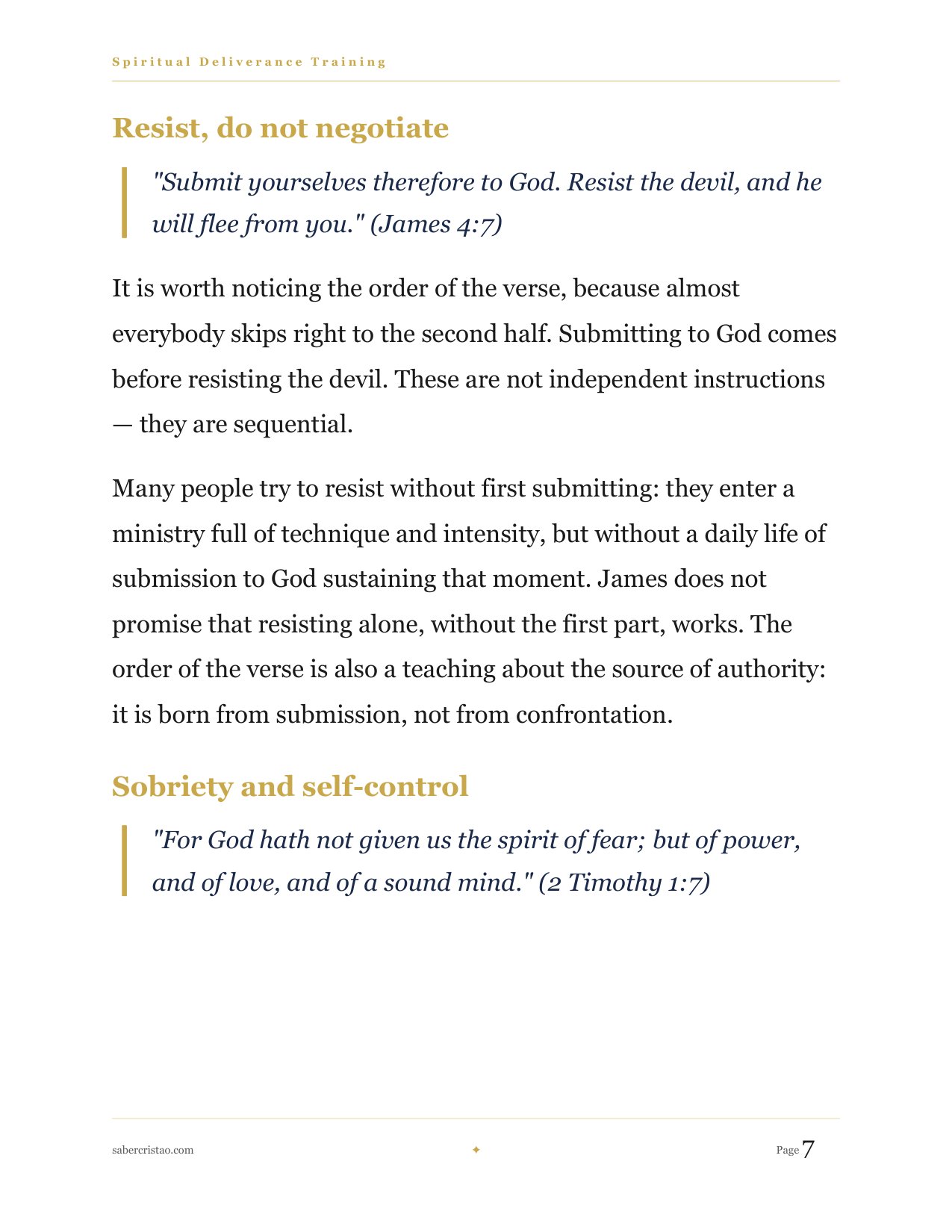
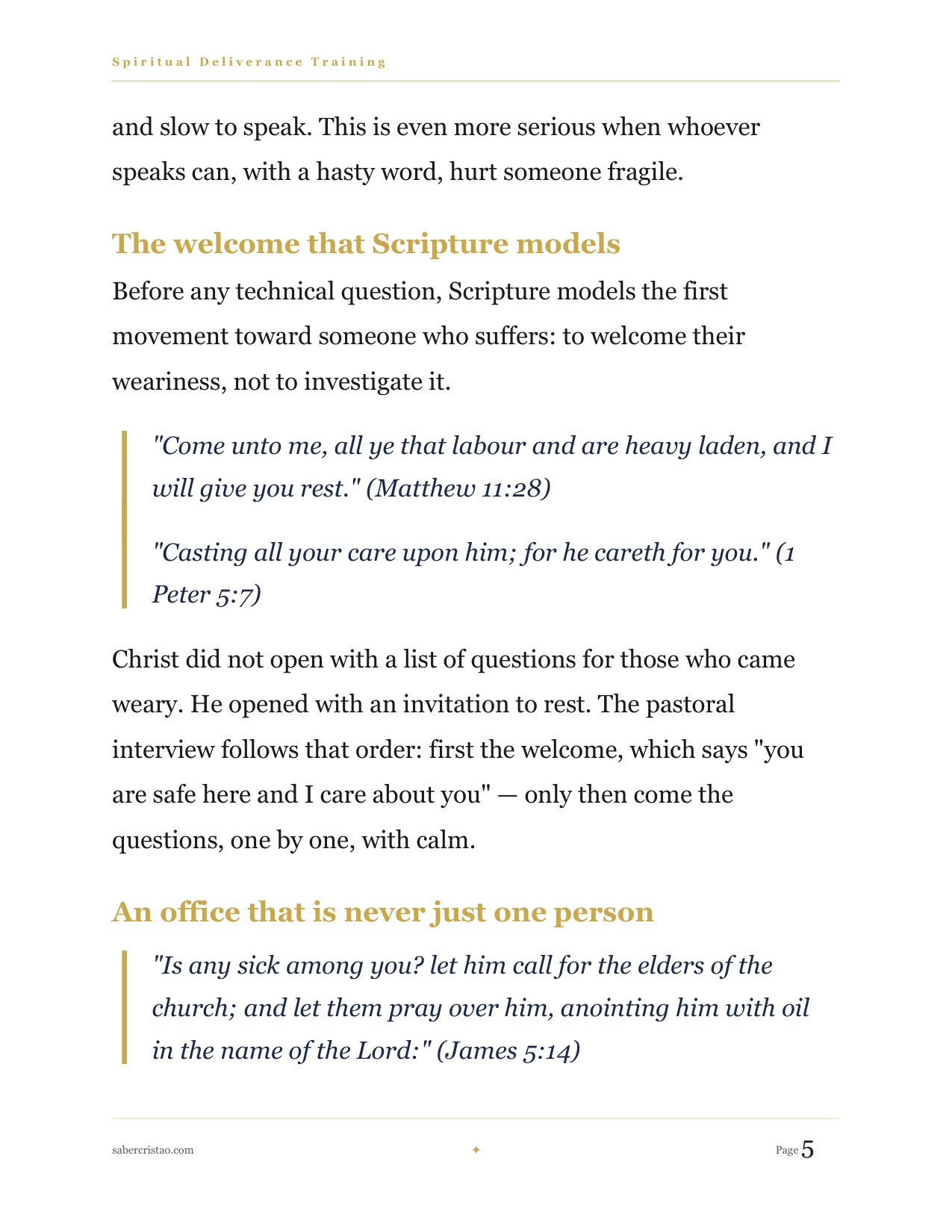
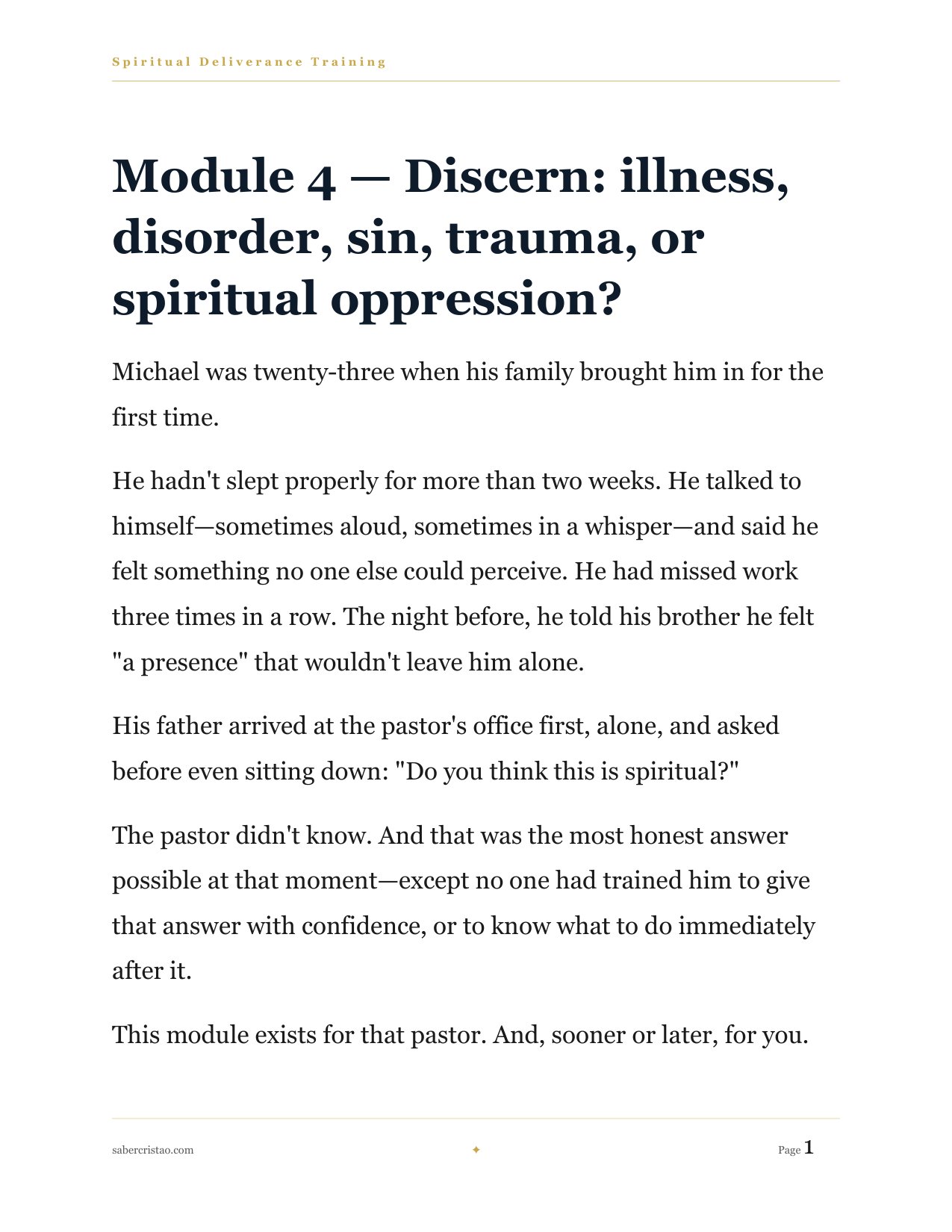
These are real pages from the material — and this is an excerpt from the first module, so you can feel the sober tone that runs through the entire training.
“Both extremes have something in common, and it's the diagnosis that frees you from both: they both eliminate the need to discern.
One decides in advance that it's never spiritual. The other decides in advance that it's always spiritual. In both cases, the minister arrives with the answer ready before hearing the person.
That's why the middle way is not lukewarm — it's the hardest of the three. It's the only one that offers no shortcut.”
“And having spoiled principalities and powers, he made a shew of them openly, triumphing over them in it.”Colossians 2:15 · KJV
It treats everything as emotional or cultural. It resolves the discomfort by erasing a category the Bible treats as a matter of course — and leaves the believer with no instruction for something Scripture affirms is real.
It sees demonic activity in every difficulty. It turns a service into an event, suffering into a spectacle, and confuses illness with possession. That's not more spiritual — it's less biblical.
You've felt uncomfortable on both sides. That discomfort isn't a lack of spirituality on your part — it's your discernment working before you have the words to explain it.
Matthew 4:24 lists, side by side, the sick, the demon-possessed, the lunatics, and the paralyzed. Distinct categories, not synonyms. Whoever doesn't distinguish between them isn't being more spiritual — they're being less careful than the text itself.
The four seasons organize the entire training, from the biblical foundation to following up with the person who was ministered to.
A sequence that starts with what the Bible teaches and ends with a ministry culture that lasts — without ever becoming a spectacle.
Why both get it wrong, what they have in common, and the biblical place between them.
What Scripture affirms, what it mentions without detail, and where it stays silent.
Ministering from the victory of Colossians 2:15 — no formulas, no shouting.
The most important module: the five conditions, the warning signs, and the golden rule — when in doubt, refer first.
Biblical criteria without the lists that produce fear and guilt.
The conversation script, block by block, and the questions that reveal whether this case is yours to handle.
Who can be on the team, who shouldn't, and the rule of never ministering alone.
The complete session script — including what to do if there's a manifestation.
The structure, part by part, with teaching before ministry and a private room, always.
The list of prohibitions that protects the person, the team, and the church — to read aloud.
The 30-day plan that establishes the person once the spotlight fades.
Criteria, scheduling, and accountability — and how to correct an existing culture without causing a split.
The training organizes application into four seasons — and this is the path for your first four weeks, from the foundation to follow-up.
Read Modules 1 through 3 and align the foundation with your team: what the Bible teaches, the two extremes to avoid, and the shared vocabulary everyone will use.
Apply the criteria from Modules 4 through 6: the five conditions that look alike from the outside, the points of entry, and the pastoral interview — recording every case with the session forms.
Lead your first supervised session using Modules 7 through 10 — the preparation of the minister and the team, the one-on-one session, an orderly service, and the list of what never to do.
Begin the follow-up from Modules 11 and 12: the 30 days that establish the person in the faith, and the ministry culture that never becomes a spectacle.
Real testimonials from Saber Cristão students, published with permission.
I was already a believer, but I was carrying a weight I couldn't explain. Fear at night, anxiety, and the sense that something always came back. The training helped me understand what was a spiritual root and what was a wound in the soul. I started applying what I learned through prayer, the Word, and forgiveness. Peace returned little by little. It wasn't instant — it was a process. Today I sleep better, and I can pray without that tightness in my chest.
I served, I fasted, and I still felt stuck. I thought deliverance was only for people who were "deeply bound." The training showed me that a lot of faithful believers still live with open doors from old hurt, old sin, and family patterns. I learned to address that with order, discernment, and responsibility. My prayer life changed. I stopped fighting in the dark and started walking with more authority and clarity.
I had carried hurt for years. I forgave with my mouth, but my heart stayed bound. It affected my marriage, my kids, and even my joy at church. The training confronted me with real forgiveness and with the identity I have in Christ. It was hard, but necessary. The weight lifted. Today I don't react the same way, and I can serve without that hidden resentment.
In my family there was always a cycle: fighting, addiction, fear, and a heavy home. I had already accepted Jesus, but the pattern kept knocking on the door. The training gave me a biblical way to deal with it without despair and without spectacle. I closed doors, took responsibility, and started covering my home with the Word and constant prayer. The atmosphere changed. My kids felt it. I felt it.
Real testimonials published with permission.
“Be sober, be vigilant; because your adversary the devil, as a roaring lion, walketh about, seeking whom he may devour;”1 Peter 5:8 · KJV
You don't need revelations or secret techniques. You need clear criteria, a responsible protocol, and a prepared team — and that's exactly what this training delivers.
Someone in crisis has come to you before, and you didn't know exactly what to do — and you don't want that to happen again.
You serve on the front lines of prayer and pastoral care, and you need alignment, boundaries, and a shared protocol.
Your church has a deliverance culture, and you want to adjust the practice without creating conflict or a split.
The topic has never been taught, and you feel that leaves the flock unprotected in the face of what the Bible affirms.
In-person schools, counseling certifications, and standalone books each cover a piece of the path. Here, the four seasons, the application materials, and the service scripts arrive together, ready for your church.
You receive all seven bonuses at no extra cost when you get the main training.
Biblical authority, discernment, and pastoral care — from the first session to the 30-day follow-up.
Read the modules, get to know the scripts, and bring the criteria to your team. If within that time you don't feel you have clear criteria in hand to discern, minister, and follow up responsibly, we'll refund 100% of your investment.
No questions asked, no red tape. The risk is entirely ours.“Ye are of God, little children, and have overcome them: because greater is he that is in you, than he that is in the world.”1 John 4:4 · KJV
It's the opposite, and that's exactly why it exists. There's no horror story, no graphic description of a manifestation, no anecdote told for shock value. The tone is pastoral from beginning to end — if material on this subject entertains you, it has already failed.
Yes. The material doesn't take sides on points that divide evangelicals — cessationism versus continuationism, whether a Christian can be possessed, territorial spirits, or specific methodologies. Where a real disagreement exists, it says so, teaches what unites, and leaves the practice to your own leadership.
We teach you to discern, to minister with order, and to follow up afterward. What the Bible doesn't detail — names, hierarchies, techniques, dialogue — this material doesn't invent. Where Scripture stays silent, we stay silent too.
That's exactly why Module 4 is the most important module in the training. It covers the five conditions that get confused with each other, the signs that call for immediate medical or psychiatric referral, and the rule that runs through the entire material: when in doubt, refer first. The material is explicit that no one should ever be told to stop treatment or medication.
Yes, and the material addresses that directly: how to introduce the subject through teaching, without creating anxiety and without launching a ministry your church isn't ready for yet.
This is one of the most common cases the material addresses. There's specific guidance on correcting an existing culture without causing a split — starting with the safety criteria no one disputes, and changing the practice before the message.
Yes. All three are complete scripts, with lines and timing, ready to print. Our recommendation is to adapt them to your own style and tradition — and the material is honest that, for most churches, the closed meeting or the one-on-one session is a better fit than a public service.
You have a full 30-day guarantee. If you don't feel you have clear criteria in hand, we'll refund 100% of your money, no questions asked.
Someone is going to knock on your door in the next few months, in crisis. What you do in the first fifteen minutes will determine whether they receive real care — or become one more story of someone hurt inside a church. For $7.90, you get ready today.
Get the complete training for $7.90